“Bulking up fast” is one of the most searched phrases in fitness, and also one of the most misunderstood. Most advice around it focuses on eating more, training harder, or following a specific routine. What’s rarely explained is what actually determines how quickly muscle tissue can be built in the human body—and why that speed has limits, no matter how motivated someone is.
This article takes a different approach. Instead of listing tips or promising shortcuts, it explains how muscle gain works at a biological level, why bulking often feels slower than expected, and what factors genuinely influence the rate of progress. The goal is clarity, not motivation—so expectations match reality, and effort is directed where it actually matters.
What People Mean by “Bulking Up Fast”
When people say they want to “bulk up fast,” they are usually not talking about muscle tissue in a strict physiological sense. What they want is visible change—looking bigger, fuller, or more muscular in the mirror within a short period of time.
The problem is that several different things can change body size and appearance quickly, and muscle growth is only one of them. Body weight can increase rapidly due to higher food intake, water retention, and increased muscle glycogen. These changes can make muscles look fuller and clothes fit tighter, sometimes within days or weeks. Muscle tissue, however, does not grow on the same timeline.
Muscle growth involves the gradual construction of new contractile tissue. This process requires repeated mechanical stimulus, adequate recovery, and sustained energy availability over time. Because it happens at the cellular level, it progresses far more slowly than short-term weight or water changes.
This mismatch in timelines is where confusion starts. Early changes are often interpreted as “fast muscle gain,” while slower periods are seen as failure. In reality, most people are comparing fast-changing signals (scale weight, fullness, appearance) with a slow-changing adaptation (actual muscle tissue). Understanding this distinction is essential before discussing how fast bulking is realistically possible.
Muscle Growth Is Rate-Limited (And Always Will Be)
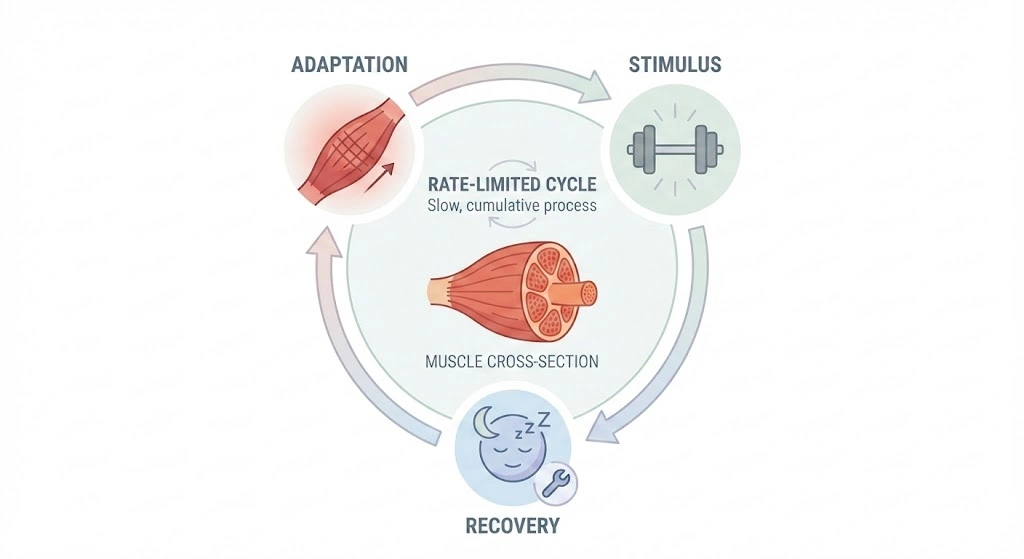
Muscle growth does not speed up simply because someone wants it to. It is governed by biological processes that place a natural limit on how quickly new muscle tissue can be built, regardless of how much food is eaten or how intense training becomes.
When muscles are exposed to resistance, they experience microscopic stress. The body responds by repairing this tissue and, over time, reinforcing it so it can better handle similar demands in the future. This adaptation requires time because it involves protein synthesis, cellular signaling, and structural changes within the muscle itself. These processes cannot be rushed without compromising recovery or increasing injury risk.
This is why muscle gain appears faster in some people than others. Beginners often see quicker changes because their muscles are highly sensitive to new training stimuli. As training experience increases, the same amount of work produces a smaller adaptive response. This does not mean progress has stopped; it means the body has become more efficient and selective about when it builds new tissue.
Attempts to force faster growth—by dramatically increasing calories, volume, or training frequency—do not override this rate limit. Instead, they often lead to excess fat gain, persistent fatigue, or stalled performance. Muscle growth is not a linear process, and pushing harder does not always move it forward faster.
Understanding that muscle gain has a built-in pace helps explain why “bulking up fast” feels difficult for most people. Progress is still possible, but it follows biological timelines rather than motivational ones.
Calories Help — But Surplus Alone Doesn’t Build Muscle
Eating more food is necessary for muscle gain, but it is not sufficient by itself. Calories provide the energy required to support growth, yet they do not instruct the body to build muscle tissue on their own.
Muscle growth occurs when the body interprets resistance training as a signal that stronger tissue is needed. Calories support this process by supplying the energy and raw materials required for repair and adaptation. Without that training signal, additional calories are simply stored, primarily as body fat.
This is why large calorie surpluses do not automatically lead to faster muscle gain. Once the body has enough energy to support recovery and adaptation, adding more does not proportionally increase muscle growth. The limiting factor shifts from energy availability to the body’s capacity to synthesize new tissue.
Excessive surpluses can also interfere with training quality and recovery. Rapid weight gain often changes how people move, affects conditioning, and increases fatigue. Over time, this can reduce training effectiveness rather than enhance it.
In practical terms, calories create the conditions under which muscle growth can happen, but they do not determine how much muscle is built or how quickly it appears. That outcome depends on how the body responds to training and how well it is allowed to recover.
For readers who want to estimate how much energy their body needs to maintain weight, a calorie calculator can provide a starting reference. These numbers are best used to understand overall energy balance, not as a guarantee of muscle gain. You can explore this further using our calorie calculator, which explains how calorie needs are estimated.
Training Is the Signal, Not the Shortcut
Resistance training does not build muscle in the moment it is performed. Instead, it sends a signal to the body that existing muscle tissue is no longer sufficient for the demands being placed on it. Muscle growth happens only if the body interprets that signal as consistent and necessary.
This is why training harder does not always lead to faster bulking. Adding more exercises, more sessions, or more exhaustion does not automatically strengthen the signal. In many cases, it weakens it by increasing fatigue without improving the quality of the stimulus.
The body responds best to training that is repeatable and progressive. When muscles are exposed to gradually increasing demands and given enough recovery, adaptation becomes likely. When training is chaotic or excessively punishing, recovery resources are diverted toward repair rather than growth.
This is also why novelty alone does not drive muscle gain. Constantly changing workouts can feel productive, but without measurable progression, the body has little reason to invest energy in building additional tissue.
Training creates the reason to grow. Calories and recovery determine whether the body can act on that reason. Without all three working together, bulking efforts tend to stall, regardless of effort.
Recovery Is Where Bulking Actually Happens
Muscle growth does not occur during training itself. It happens after training, when the body has the opportunity to repair stressed tissue and adapt to future demands. Recovery is not a passive phase of bulking—it is an active requirement.
Adequate sleep plays a central role in this process. During sleep, the body prioritizes repair, hormonal regulation, and protein synthesis. When sleep is consistently poor or insufficient, these processes are disrupted, regardless of how well training and nutrition are managed.
Recovery is also influenced by overall stress. Psychological stress, physical fatigue, and under-recovery compete for the same resources the body uses to build muscle. When those resources are diverted, muscle gain slows even if calorie intake is high.
This is why bulking can stall in people who are “doing everything right” on paper. Training provides the signal, calories provide the energy, but recovery determines whether the body can convert both into new muscle tissue. Without enough recovery capacity, the system bottlenecks.
Seeing recovery as a limiting factor—not an afterthought—helps explain why sustainable bulking often feels slower than expected but produces more reliable results over time.
Why Most People Think They’re Bulking — But Aren’t
Many people believe they are bulking consistently, yet see little or no long-term change in muscle size. In most cases, the issue is not effort or intent—it’s inconsistency hidden inside otherwise good habits.
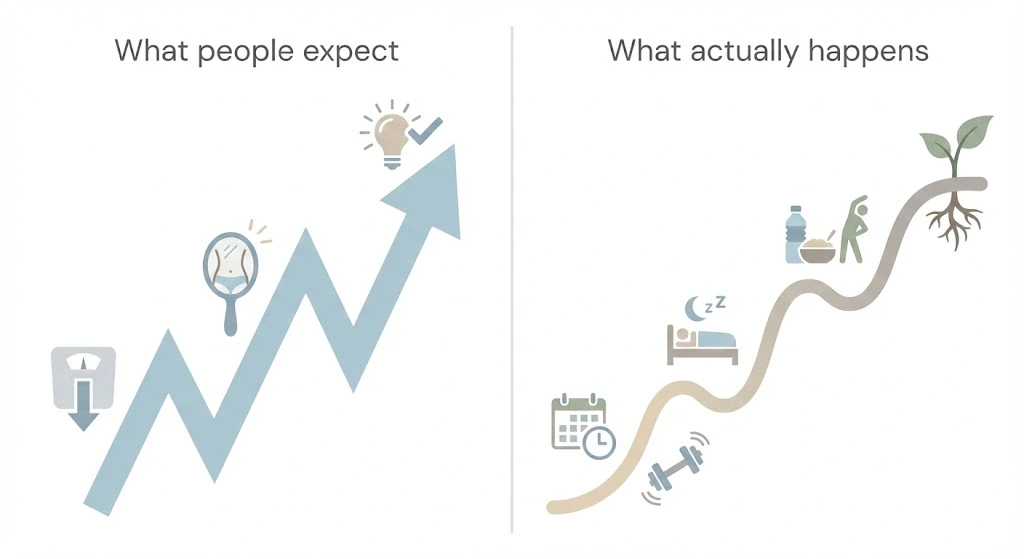
One common reason is an uneven energy surplus. Eating more on some days and unintentionally undereating on others often averages out to maintenance over time. Because appetite, activity, and daily routines fluctuate, perceived effort does not always translate into sustained energy availability.
Another factor is training without progression. Repeating workouts without gradually increasing demands can maintain strength and fitness, but it does not give the body a strong reason to build additional muscle. The work feels hard, but the stimulus remains familiar.
There is also a tendency to underestimate how much daily movement increases when food intake goes up. As energy availability rises, people often move more without noticing—walking more, fidgeting more, training harder. This automatic increase in activity can offset the intended surplus.
Finally, expectations play a role. Muscle gain does not present itself as steady, week-to-week visual change. When progress does not match imagined timelines, people assume nothing is happening and change strategies prematurely. In reality, the conditions for growth may never stay in place long enough for adaptation to occur.
Fat Gain vs Muscle Gain — Why They’re Often Confused
Muscle gain and fat gain often occur together, especially during periods of weight increase. This overlap is one of the main reasons bulking progress is misunderstood. Changes on the scale or in appearance do not automatically reflect changes in muscle tissue.
Early weight gain during a bulk is frequently driven by increased food volume, glycogen storage, and water retention. These changes can make muscles appear larger and fuller, but they do not represent new muscle tissue. Actual muscle growth takes longer to materialize and is harder to detect visually in the short term.
Because of this, fat gain is sometimes mistaken for muscle gain—or vice versa. When weight increases quickly, a portion of that gain is often body fat, even when training is effective. This does not mean bulking has failed, but it does mean that muscle gain is happening within a broader context of energy storage.
Problems arise when the distinction is ignored. Aggressive bulking approaches that prioritize rapid weight gain tend to increase fat faster than muscle, making later adjustments more difficult. Over time, this can create a cycle of bulking and cutting that feels productive but leads to minimal net muscle gain.
Understanding that muscle and fat respond differently to energy surplus helps set realistic expectations. Muscle gain rewards patience and consistency, while fat gain responds quickly to excess. Effective bulking manages this balance rather than pretending it doesn’t exist.
How Bulking Fits Into the Same Energy System as Fat Loss
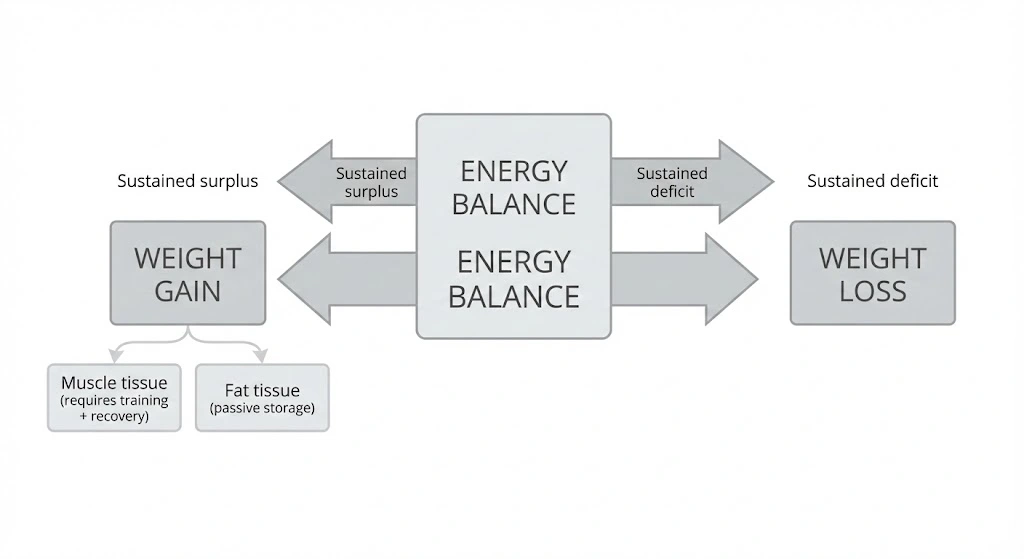
Bulking and fat loss are often treated as opposite goals, but biologically they are governed by the same underlying system: how the body manages energy over time. The body does not switch between separate “modes” for gaining and losing weight. It continuously responds to energy availability, training demands, and recovery capacity.
When energy intake consistently exceeds energy needs, body weight increases. When intake consistently falls below needs, body weight decreases. What changes within that weight—muscle, fat, or a combination of both—depends on how the body is being stimulated and supported.
This is why understanding fat loss helps clarify bulking as well. In both cases, the body prioritizes efficiency. It stores excess energy readily, but builds muscle selectively and slowly. Training provides direction, energy availability provides permission, and recovery determines how much adaptation actually occurs.
Viewing bulking through this lens removes much of the confusion around speed. Muscle gain is not slowed by a lack of effort; it is constrained by the same biological principles that govern fat loss and weight change in general. These principles are explained in more detail in our guide on how fat loss works, which outlines how the body responds to sustained changes in energy balance.
Once bulking is understood as part of this broader system, it becomes easier to see why extreme approaches rarely work as intended and why steady, repeatable conditions matter more than aggressive tactics.
The Bottom Line on Bulking Up Fast
Bulking up fast does not mean bypassing the body’s natural limits. It means creating the most efficient conditions for muscle growth and maintaining them long enough for adaptation to occur.
Muscle growth follows biological timelines, not motivational ones. Calories support the process but do not control it. Training provides the signal, recovery enables adaptation, and consistency determines outcomes. When any of these elements is unstable, progress slows—regardless of effort.
For most people, the fastest way to bulk is not through extremes, but through restraint: avoiding unnecessary surplus, training with intent rather than exhaustion, and allowing recovery to keep pace with demand. These factors do not produce dramatic short-term changes, but they are the ones that reliably lead to visible, lasting muscle gain.
Understanding how muscle growth actually works removes much of the frustration around bulking. Progress becomes easier to evaluate, expectations become realistic, and effort is directed where it produces meaningful results.
At LiveFitNow, we focus on explaining how body composition actually changes so people can make sense of conflicting fitness advice without relying on shortcuts or hype.