Losing weight can feel simple in theory — eat less, move more, and the scale goes down. But if you’ve ever been in a calorie deficit and still watched the scale stall, you’re not alone.
A weight loss stall — sometimes called a plateau — is one of the most frustrating parts of a fat-loss journey. It can happen even when you think you’re doing everything “right,” and it’s not because you lack willpower or effort.
In this article, we’ll explain exactly why this happens, based on how the body actually responds to a calorie deficit, and what evidence-based factors influence continued fat loss. No quick fixes. No recycled tips. Just real understanding so you can move past the plateau with confidence.
What a Weight Loss Plateau Really Is
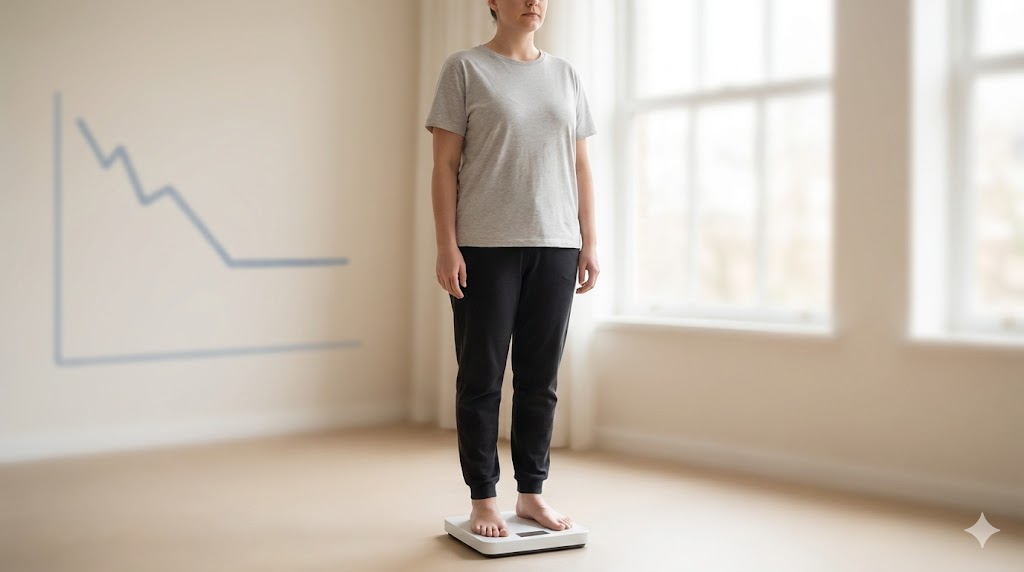
A weight loss plateau is not your body “refusing” to lose fat. It’s your body adjusting.
When you first reduce calories, your body responds quickly. You lose water weight, glycogen, and some fat. The scale moves. That early progress feels motivating.
But as weeks go by, something important happens:
Your body begins to adapt to the lower calorie intake.
This adaptation affects:
- Resting calorie burn
- Hormone levels related to hunger
- Daily movement (even the small, unconscious kind)
- How efficiently your body uses energy
The result?
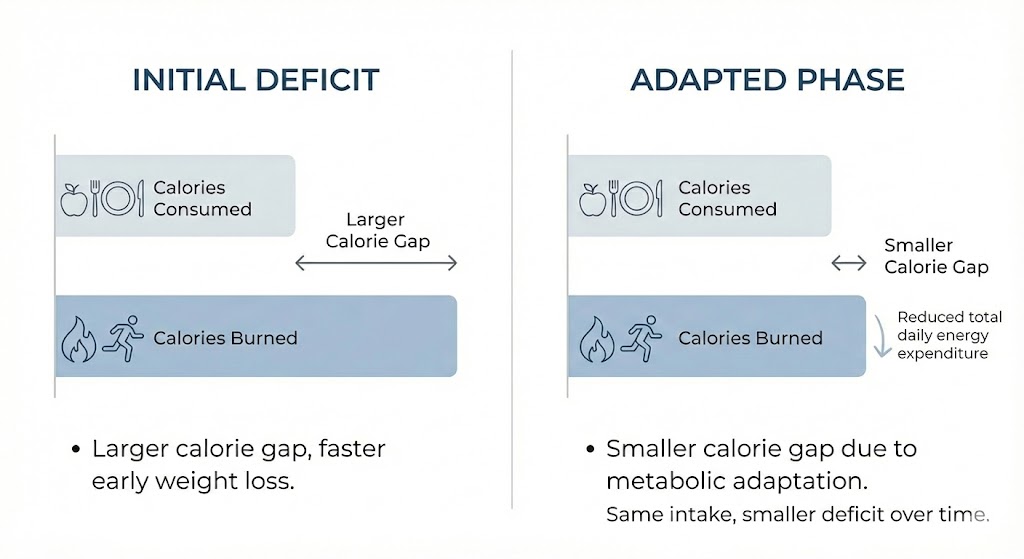
The calorie deficit that worked in the beginning becomes smaller over time — sometimes without you realizing it.
That’s what most people call a plateau.
It’s not that fat loss stops completely.
It’s that the gap between calories in and calories out quietly shrinks.
Why Eating Less Doesn’t Always Mean a Bigger Deficit
At first, weight loss feels straightforward: reduce calories, and the body uses stored fat for energy. But the body is not passive. It constantly adjusts to protect itself from prolonged energy shortages.
This adjustment is called metabolic adaptation.
Metabolic adaptation means your body gradually reduces the amount of energy it burns when calorie intake stays low for a while. It’s not dramatic or sudden — it’s subtle. But over weeks, it adds up.
Here’s what changes:
1. Your Resting Metabolic Rate Decreases
Your resting metabolic rate (RMR) is the amount of calories your body burns at rest just to keep you alive — breathing, circulating blood, maintaining organs.
When you lose weight, your body mass decreases. A smaller body requires fewer calories to maintain. That’s normal.
But beyond that expected drop, the body may reduce energy use slightly more than predicted. This is the adaptive part. It becomes more efficient with the calories you give it.
The same calorie intake that once created a 500-calorie deficit may now create a much smaller one.
2. Non-Exercise Activity Quietly Drops (NEAT)
One of the least talked about factors is NEAT — Non-Exercise Activity Thermogenesis.
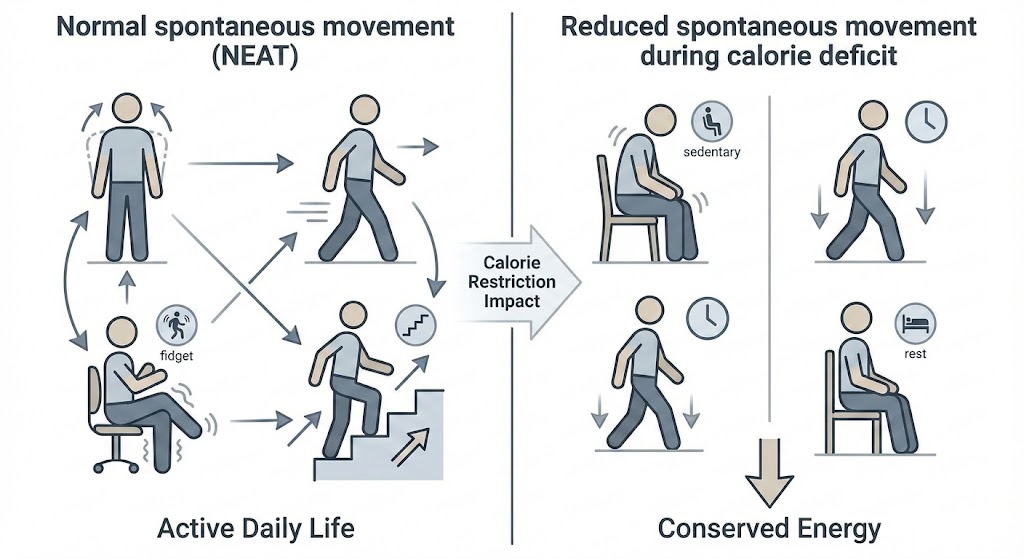
NEAT includes:
- fidgeting
- walking around
- posture shifts
- unconscious movement
When calories are reduced, the body often lowers spontaneous movement to conserve energy. You may sit more. Move less. Feel slightly more tired. Not enough to notice clearly — but enough to reduce daily calorie burn.
This alone can shrink a deficit by hundreds of calories without any change in workouts.
3. Hunger Hormones Increase
Hormones like ghrelin (which increases hunger) tend to rise during calorie restriction. Meanwhile, signals related to fullness may decrease.
This doesn’t mean your body is broken. It means your body is responding to lower energy availability.
Over time, increased hunger makes it easier to:
- underestimate intake
- snack slightly more
- reduce dietary consistency
Even small increases in intake can erase a narrow deficit.
How to Tell If It’s a Real Plateau or Just Normal Fluctuation
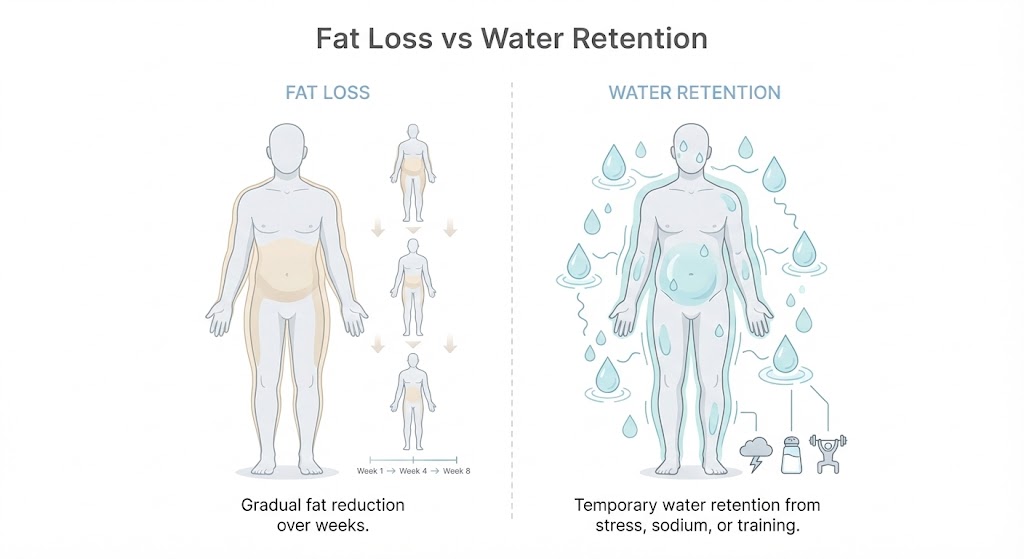
Before assuming fat loss has stopped, it’s important to understand how body weight actually behaves.
The number on the scale does not only reflect fat.
It also reflects:
- Water retention
- Glycogen storage (stored carbohydrates)
- Digestive content
- Hormonal fluctuations
- Inflammation from training
All of these can shift daily — sometimes by 1–2 kilograms — without any change in body fat.
Short-Term Scale Stalls Are Normal
If your weight hasn’t changed for 3–7 days, that is not a plateau.
Daily body weight fluctuates naturally. Even sodium intake, stress, poor sleep, or a hard workout can temporarily increase water retention.
Fat loss happens gradually, but water shifts can happen quickly.
That’s why the scale may appear stuck even when fat loss is continuing underneath.
A True Plateau Has a Pattern
A real weight loss plateau usually means:
- No measurable weight change for 2–4 weeks
- Calorie intake has been consistent
- Activity level has not decreased
- Strength levels are stable or declining
The key word is trend.
Single weigh-ins mean very little.
Weekly averages over time tell the real story.
Why Water Retention Masks Fat Loss
When you’re in a calorie deficit, especially during stress or intense training, the body can retain water temporarily.
Cortisol — a stress-related hormone — can increase fluid retention.
Muscle repair from workouts can also draw water into tissues.
This can offset fat loss on the scale, creating the illusion that nothing is happening.
But underneath that temporary water layer, fat loss may still be occurring.
The Most Common Mistake
The biggest mistake people make during a perceived plateau is reacting too quickly.
They:
- Cut calories further
- Add excessive cardio
- Panic and change everything
If the stall was caused by normal fluctuation, these aggressive changes create unnecessary stress and make long-term progress harder.
Patience is often more effective than immediate adjustment
What to Do When Weight Loss Actually Stalls
If you’ve confirmed it’s a real plateau — not just daily fluctuation — the solution is not to slash calories immediately.
A stall means your previous deficit has likely shrunk. The goal is to restore a small, sustainable gap — not create a drastic one.
Here’s how to approach it calmly and strategically.
1. Recalculate Based on Your Current Body Weight
As body weight decreases, energy needs decrease.
The calorie intake that created fat loss at 85 kg may no longer create the same deficit at 80 kg.
This doesn’t mean your metabolism is broken.
It means your body is lighter and requires fewer calories.
Recalculate your maintenance calories based on your current weight, then adjust slightly if needed.
Small changes are usually enough.
2. Check Consistency Before Changing Anything
Before adjusting calories, ask:
- Has tracking been consistent?
- Has activity level dropped subtly?
- Has sleep quality changed?
Sometimes stalls are behavioral drift rather than metabolic adaptation.
Even small increases in portion sizes or small decreases in daily movement can close a narrow deficit.
This step is about awareness — not blame.
3. Increase Movement Before Cutting Food Further
If calories are already moderate, adding a small amount of movement is often smarter than eating significantly less.
This could mean:
- An extra 2,000–3,000 steps per day
- Slightly longer walks
- Minor increases in training volume
Increasing output tends to be more sustainable than aggressive food restriction.
4. Avoid Extreme Calorie Cuts
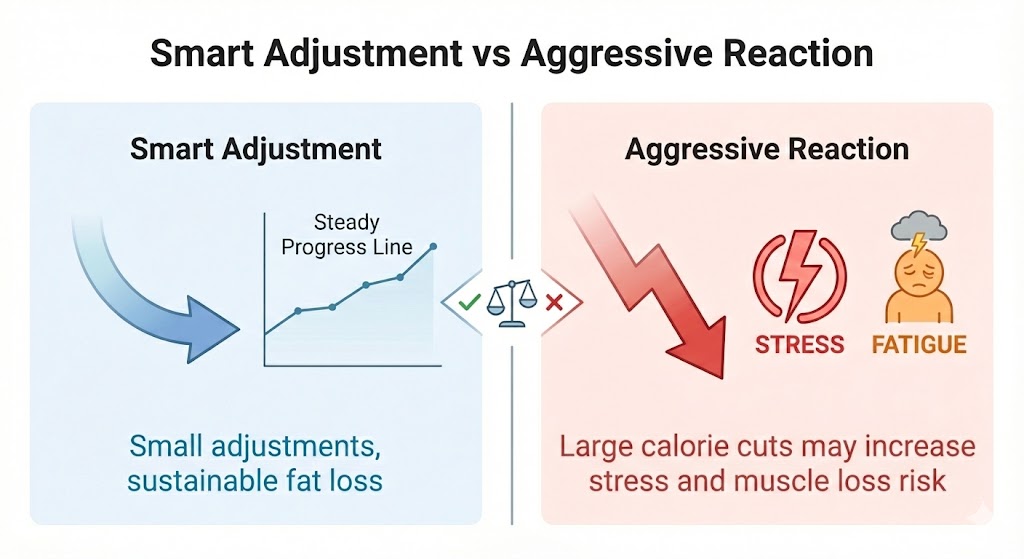
Large, sudden calorie reductions can:
- Increase fatigue
- Raise hunger hormones
- Reduce training performance
- Increase muscle loss risk
A plateau is rarely fixed by drastic measures.
Small, controlled adjustments maintain long-term progress.
5. Consider a Short Maintenance Phase
In some cases, staying at maintenance calories for 1–2 weeks can help:
- Reduce diet fatigue
- Stabilize hormones
- Improve training performance
- Reset psychological stress
This is not “giving up.”
It can improve adherence and preserve muscle before resuming fat loss.
The Real Goal
The goal is not to force weight down every week.
The goal is to maintain a controlled deficit while preserving muscle, energy, and sustainability.
Fat loss is not linear.
Progress often looks like:
Two steps forward.
Pause.
Then forward again.
The Bottom Line: Weight Loss Plateaus Are Normal — Not Failure
A weight loss plateau is not a sign that your body is broken. It’s a sign that your body has adapted.
When you reduce calories, your body responds. It becomes slightly more efficient. It burns a little less energy. Hunger signals may increase. Spontaneous movement may decrease. Over time, the original deficit that created fat loss quietly shrinks.
That doesn’t mean progress is over.
It means the strategy needs a small adjustment — not a drastic reaction.
Before cutting calories further, confirm it’s a true plateau and not normal scale fluctuation. Look at trends, not single weigh-ins. Assess consistency. Consider small changes rather than extreme ones.
Fat loss is not linear.
It rarely moves in a straight downward line.
Progress often comes in phases:
- Initial drop
- Stabilization
- Adjustment
- Continued loss
Understanding this removes panic from the process.
The goal is not to force weight down at any cost.
The goal is to reduce body fat while preserving health, muscle, and long-term sustainability.
When you understand how the body adapts, a plateau stops feeling like a mystery — and becomes part of a predictable process.
Frequently Asked Questions About Weight Loss Plateaus
Eating less does not always mean you’re still in a calorie deficit. As you lose weight, your body burns fewer calories, and spontaneous movement often decreases. Over time, the deficit that worked initially may shrink. Additionally, water retention can temporarily mask fat loss, making progress appear stalled even when fat loss is still occurring.
A true plateau typically means no measurable weight change for two to four weeks despite consistent calorie intake and activity. Shorter stalls are often caused by normal water fluctuations. The duration depends on how quickly adjustments are made and how well consistency is maintained.
Yes, to a degree. As body weight decreases, energy needs naturally decrease. Beyond that, metabolic adaptation may slightly reduce calorie burn to conserve energy. This is a normal physiological response — not permanent damage — and can be managed with small, strategic adjustments.
Not immediately. First confirm that the plateau is real and not due to water retention or inconsistency. If a deficit truly no longer exists, small adjustments — either slightly reducing calories or increasing movement — are usually more effective than aggressive calorie cuts.
Stress does not stop fat loss directly, but it can increase water retention and influence hunger signals. Elevated stress may also reduce sleep quality and daily movement, indirectly affecting calorie balance. Managing stress supports consistency and improves long-term fat loss outcomes.
Scientific References
- Sumithran P et al. (2011). Long-term persistence of hormonal adaptations to weight loss. New England Journal of Medicine.
- Hall KD et al. (2016). Energy expenditure and metabolic adaptation during weight loss. Obesity.
- Rosenbaum M & Leibel RL. (2010). Adaptive thermogenesis in humans. International Journal of Obesity.